

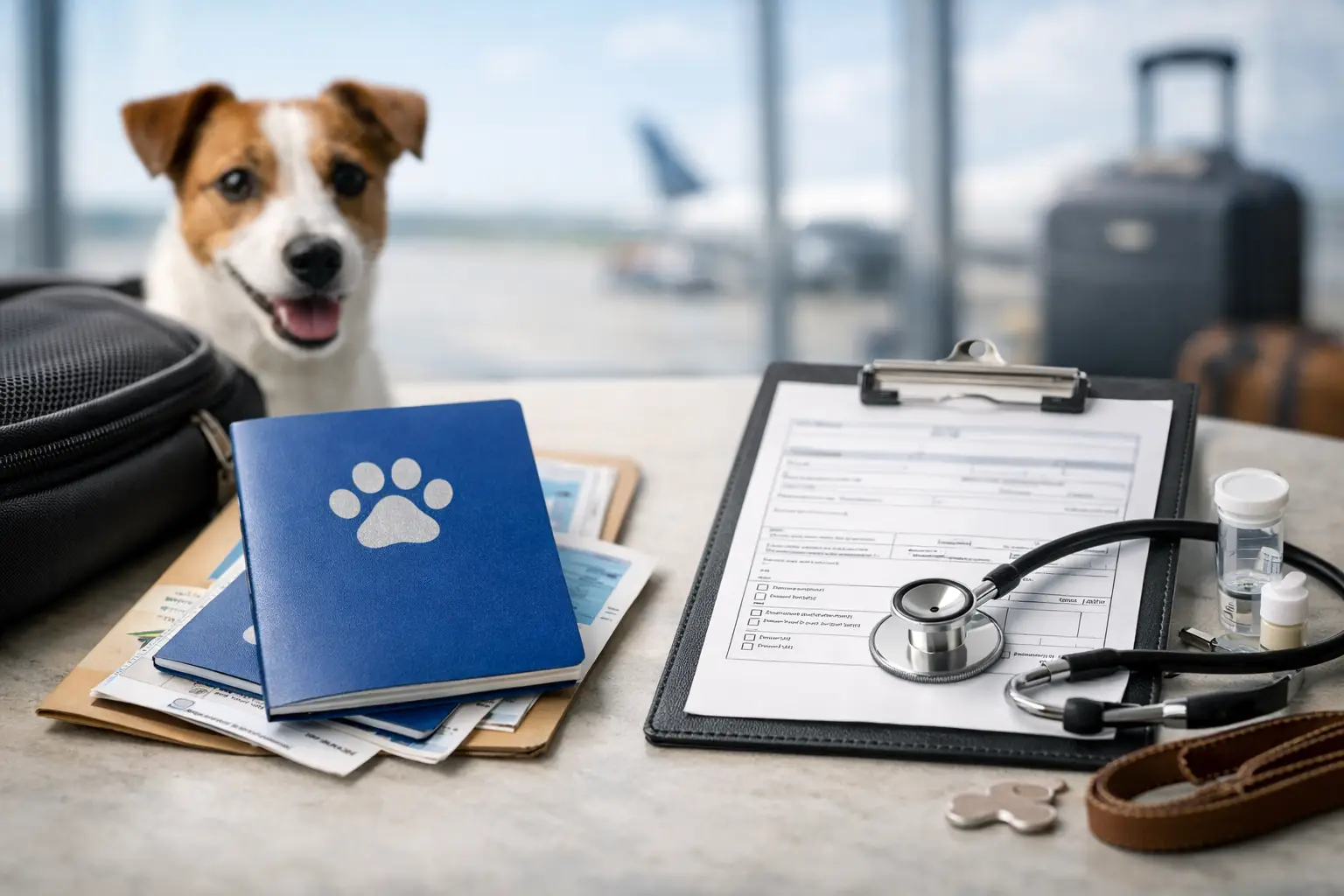
A last-minute holiday abroad is exciting until someone mentions pet paperwork. Suddenly, “pet passport versus certificate” becomes a very real question - and getting it wrong can mean a stressful delay at the border, or your pet being refused travel altogether.
The short answer is that most pets travelling from Great Britain to the EU now need an Animal Health Certificate, often called an AHC. But the right document depends on where you are going, where your pet’s existing documents were issued, and whether you are travelling for a holiday, moving abroad or using a commercial transport company.
🐾 What is a pet passport?
A pet passport is an official document that records a pet’s microchip number, rabies vaccination and certain treatments. It is not simply a booklet you can buy or a letter from a vet. For travel purposes, it must be issued by an authorised vet in an eligible country.
The big point for British pet owners is this: pet passports issued in Great Britain are no longer valid for travel into the EU, Northern Ireland, Switzerland, Norway, Iceland, Liechtenstein, Andorra, Monaco, San Marino or Vatican City.
That does not mean every passport has become useless. If your dog or cat has a valid passport issued in an EU country or Northern Ireland, it can usually still be used, provided the microchip and rabies vaccination details are correct and up to date. An EU-issued passport can make repeat trips much simpler.
A passport is designed to be an ongoing travel record. Once it is valid, you do not normally need a fresh document for every trip. The rabies vaccination must not lapse, though. If it does, the travel clock may effectively restart.
📄 What does “certificate” mean for pet travel?
“Certificate” is a broad word, which is where much of the confusion starts. It can mean several very different documents, and they are not interchangeable.
For a straightforward holiday from England, Scotland or Wales to the EU, the certificate people usually mean is an Animal Health Certificate . This is a legal travel document completed by an Official Veterinarian after checking your pet’s identity, microchip and rabies vaccination record.
An Animal Health Certificate is generally suitable for a non-commercial trip with up to five pets, where you are travelling with them or within five days of them. It covers entry into the EU and can also be used for onward travel between EU countries.
Other paperwork may also be called a certificate. A rabies vaccination certificate confirms the vaccine details, but it is not normally enough by itself to enter the EU from Great Britain. A fit-to-fly certificate may be requested by an airline, but it does not replace an AHC. An export health certificate is usually needed for destinations outside the standard EU pet travel route, or in more complex travel situations.
So, if someone tells you that your pet “just needs a certificate”, ask which certificate and for which country. That one question can save a lot of panicked phone calls later.
Pet passport versus certificate: the practical difference
Think of the difference this way. A valid EU or Northern Ireland pet passport is a reusable travel document. An Animal Health Certificate is a one-trip document issued for a specific journey.
An AHC must be issued no more than 10 days before you enter the EU. From its date of issue, it is normally valid for 10 days to enter the EU, then for onward travel within the EU for up to four months, and for return to Great Britain within four months. If you plan another European holiday later in the year, you will usually need another AHC unless your pet obtains a valid EU-issued passport in the meantime.
That makes the choice less about preference and more about your pet’s circumstances. A family taking their dog to France for two weeks will normally need an AHC. Someone whose pet already holds a valid French, Spanish or Irish passport may be able to travel using that passport instead. A move to Australia, the USA or another non-EU destination calls for country-specific advice, because requirements can be very different.
✅ The checks that must happen before an AHC
Paperwork cannot repair a missing microchip or an invalid rabies vaccination at the last minute. Before an Animal Health Certificate can be issued, your pet needs a readable microchip and a current rabies vaccination recorded against that microchip number.
For a first rabies vaccination, or a booster given after the previous vaccine has expired, there is usually a 21-day wait before travel. Your pet must be at least 12 weeks old on the day of vaccination, which means very young puppies and kittens cannot travel immediately.
The order matters too. Your pet must be microchipped before, or on the same day as, the rabies vaccination. If the vaccine was given before the chip was implanted, it may not count for travel purposes, even if your pet has otherwise been perfectly well cared for.
This is why we suggest starting the process well before you book non-refundable travel. The veterinary check itself may be straightforward, but the legal timing around a rabies vaccination is not something any vet can waive.
🐶 Do dogs need a tapeworm treatment?
If you are travelling to Finland, Ireland, Malta, Norway or Northern Ireland with a dog, yes, a tapeworm treatment is normally required before entry. It must be given by a vet and recorded in the relevant travel document between 24 and 120 hours before arrival.
Cats do not need this treatment for travel. Dogs travelling to many other EU countries do not either, but it is always sensible to check the current rules for every country on your route. Requirements can apply to transit countries as well as your final destination.
✈️ When a standard AHC may not be enough
An AHC is not a catch-all passport for the whole world. Some destinations require blood tests, parasite treatments, import permits, approved laboratory results or documents completed much further in advance. Airlines and ferry companies can also have their own carrier rules about crate size, check-in times, permitted breeds and whether pets can travel in the cabin.
There are also different rules where a pet is travelling without its owner, travelling more than five days before or after its owner, or where more than five pets are moving together. These trips may be treated as commercial movement rather than ordinary pet travel, even if no money is changing hands.
If you are relocating, buying a puppy from overseas, travelling for a competition, or sending your pet ahead with a transport company, say so when you ask for advice. The detail matters.
🏠 Making the appointment less of a headache
Travel paperwork has a reputation for being fiddly because it is detail-heavy. Names must match, dates must be right, chip numbers must be read accurately and original vaccination records need checking. It is worth allowing enough time for the appointment rather than trying to squeeze it in during a rushed lunch break.
Have your pet’s previous passport, vaccination card or rabies certificate ready, along with your travel date, destination and the countries you will pass through. If you are returning by a different route, mention that too. A clear plan gives your vet the best chance of spotting a requirement before it becomes a problem.
At Vet on the Loose, travel paperwork can be discussed in an unhurried home consultation where appropriate - less carrier drama for your cat, less waiting-room tension for your dog, and time for you to ask the questions that are easy to forget when everyone is in a queue.
A calm way to plan your pet’s trip
The paperwork is there to protect animal and public health, but it should not overshadow the trip itself. Start with the destination’s rules, check the rabies dates early and treat the document as part of the holiday planning, not an afterthought. Once the right certificate or passport is in place, you can get back to the nicer decisions - where the lead, treats and favourite blanket are going to fit.