

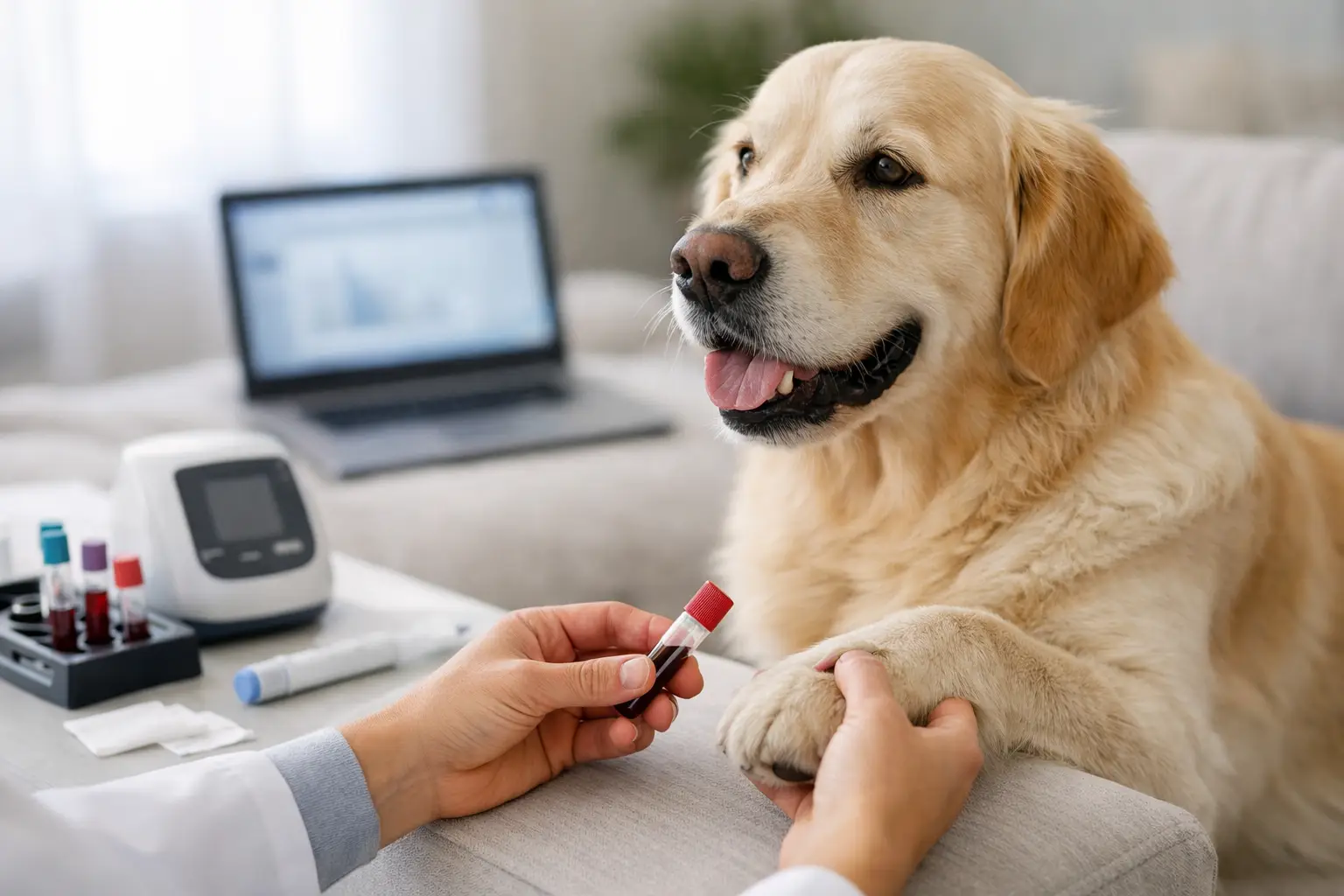
A blood test can sound daunting, especially when your dog is already off their food, drinking more than usual or simply not quite themselves. Dog blood tests at home can take away one big source of stress: the car journey, busy waiting room and unfamiliar smells that can make an anxious dog harder to assess.
For many dogs, being tested in their own kitchen, living room or favourite sunny spot means they can settle more quickly. For owners, it can mean a proper conversation with the vet without trying to keep one eye on the clock and the other on a nervous Labrador wrapping their lead around the chairs.
That said, an at-home blood test is not the same as buying a DIY kit, posting a sample away and hoping the result gives you an answer. Blood results only make sense alongside your dog’s history, examination and symptoms. The number on a report matters, but so does the dog in front of us.
🩸 What can dog blood tests at home check?
A vet can take blood samples during a home consultation and send them to a professional laboratory for analysis. Depending on what is worrying you, the tests may look at blood cells, organ function, hormones or signs of inflammation.
A full blood count measures red cells, white cells and platelets. It may help investigate anaemia, infection, inflammation or problems with clotting. Biochemistry tests give us information about organs including the kidneys and liver, as well as blood sugar, proteins and electrolytes.
For an older dog, blood testing can also be useful as part of a general health check. It can reveal changes that are not yet obvious at home, or provide a helpful baseline to compare with future results. In a dog starting certain long-term medications, it may be used to check that their organs are coping well with treatment.
More targeted testing is sometimes needed. This could include thyroid testing, pancreatitis markers, tests for particular infectious diseases, or monitoring conditions such as diabetes and Cushing’s disease. Your vet should explain what each test is for before taking a sample, rather than handing you a mysterious bill full of abbreviations afterwards.
When a home visit makes particular sense
Home sampling is especially helpful for dogs who find a surgery overwhelming. Some become tense as soon as they see the car keys. Others are perfectly friendly at home but frightened around other animals, slippery floors, clinical smells or unfamiliar handling.
It can also be a kinder option for dogs with mobility problems, arthritis, poor eyesight or severe illness. Asking a frail dog to climb into a car and wait in a strange environment is not always necessary. A calm visit at home lets the vet see how your dog moves, rests and behaves in their usual surroundings too.
For busy families, older owners and multi-pet households, there is a practical benefit as well. There is no carrier wrestling, arranging lifts or trying to coordinate several pets in one stressful trip. At Vet on the Loose, home consultations are a minimum of 30 minutes, allowing time to talk through the concern, examine your dog properly and take samples without the usual rush.
🐾 When should you ask for a blood test?
Blood tests are not needed for every minor wobble. A one-off episode of vomiting in a dog who is otherwise bright may need rest, observation and sensible advice rather than immediate laboratory work. Equally, waiting too long when a dog is clearly unwell can make a problem harder and more expensive to treat.
It is worth speaking to a vet promptly if your dog has persistent vomiting or diarrhoea, a noticeable change in thirst or appetite, weight loss, reduced energy, pale gums, yellow skin or eyes, unexplained bruising, repeated urinary accidents, or a change in breathing. These signs can have many causes. Blood testing helps narrow the possibilities, but it does not replace an examination.
A test may also be recommended before an anaesthetic, before starting a medicine, or as part of monitoring an existing health condition. This is not always about finding bad news. Sometimes the most reassuring outcome is confirming that a dog’s kidney values, liver markers or blood sugar are stable.
If your dog has collapsed, is struggling to breathe, has a swollen abdomen, cannot keep water down, has severe pain, or seems suddenly weak or disorientated, they may need urgent in-person treatment rather than a routine home appointment. Call a vet straight away and be guided by the urgency of the symptoms.
What happens during an at-home blood sample?
Most blood samples are taken from a vein in a front leg or, occasionally, the neck. The area may be clipped if needed, cleaned, and held gently while a small needle is used. Many dogs barely react. Some need a little more reassurance, a favourite treat or a calm pause before trying again.
There is no point pretending every dog loves it. A needle is still a needle. But a familiar room, their own bed and a relaxed owner nearby can make an enormous difference. If your dog is worried, the appointment should move at their pace where it safely can. A few minutes of calm handling is usually better than forcing the issue.
Once collected, the sample is labelled and sent to the laboratory. Some results are available quickly, while others take longer depending on the test. Your vet should tell you what timing to expect, how results will be shared and what the possible next steps might be.
DIY blood kits versus veterinary testing
At-home testing kits can look appealing, particularly when they promise quick answers or a lower upfront cost. The trade-off is that collecting a good-quality blood sample from a dog is not simple, and interpreting results without a clinical examination can be misleading.
A result outside the reference range does not automatically mean disease. Values can shift with stress, hydration, age, breed, recent meals and medication. Equally, a result that looks normal does not rule out every problem. A dog with concerning symptoms still needs veterinary advice, whatever a home kit says.
Professional sampling also reduces the risk of an unsuitable sample. Blood can clot, become damaged during collection or be delayed in transit, making some results unreliable. Paying for a test that cannot answer the question is frustrating for everyone, particularly when you are trying to keep veterinary costs under control.
The sensible middle ground is to use testing for a clear reason. Ask what the vet is looking for, whether the result will change the treatment plan and what the likely costs are before proceeding. Clear choices are better than a scattergun panel of tests that creates more uncertainty than reassurance.
Preparing your dog without making a fuss
Your vet will tell you if your dog needs to fast before the appointment. Some blood tests are affected by food, but fasting is not suitable for every dog, especially puppies, diabetic dogs or those who are unwell. Never withhold food unless you have been specifically advised to do so.
On the day, keep things ordinary. Let your dog have a toilet break, keep their lead nearby and have a few high-value treats ready if they can eat them. There is no need to scrub a patch of fur or attempt your own sample beforehand. Your main job is to be calm, because dogs are remarkably good at noticing when we are anxious.
Have any medication, supplements and previous test results to hand. It is also useful to jot down when symptoms started, changes in food or drinking, and anything that seems to make the issue better or worse. Small details often help build the bigger clinical picture.
Results are a starting point, not the whole story
Waiting for results can be worrying. Try not to search individual numbers online before you have spoken to the vet. Reference ranges are guides, not verdicts, and one slightly raised value may mean something very different in a lively young dog than in a senior dog with weight loss and increased thirst.
Sometimes a result gives a clear direction and treatment can start straight away. Sometimes it suggests a recheck, urine testing, an ultrasound or referral. And sometimes it confirms that watchful waiting is appropriate. Good veterinary care is not about ordering every possible test. It is about choosing the tests that genuinely help your dog.
If your dog needs blood testing, being at home can turn a potentially stressful errand into a quieter, more considered appointment. Put the kettle on, keep their favourite treats close, and give yourself permission to ask every question you need to ask. Your dog deserves care that fits around real life, not the other way round.