

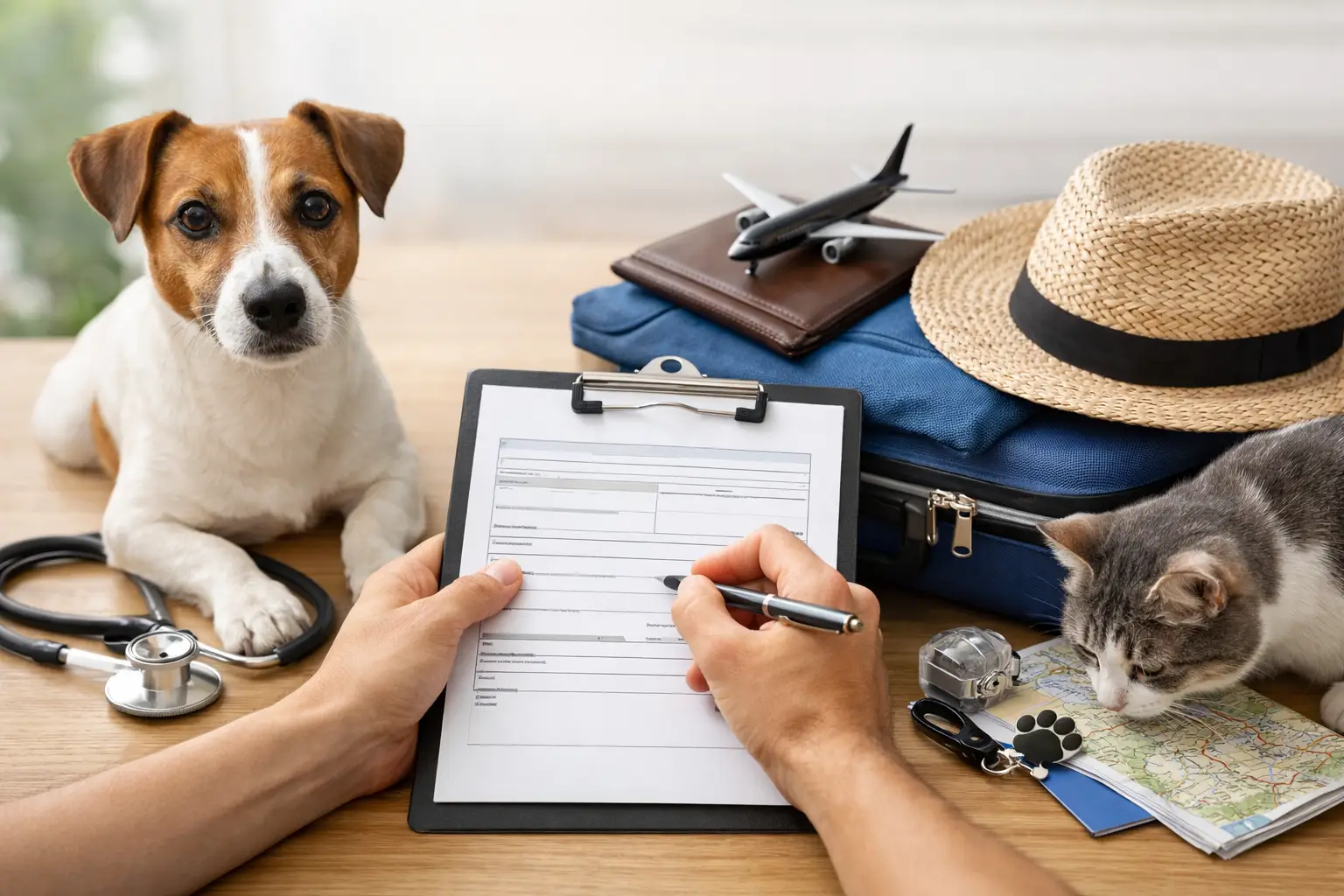
That holiday countdown feels rather less exciting when you realise your dog or cat needs official travel paperwork. An animal health certificate appointment is not something to leave until the week before you go. The certificate itself must be issued close to travel, but the preparation often starts weeks earlier - especially if a rabies vaccination is needed.
The good news is that the process is usually straightforward when you know the rules, have the right documents ready and book at the right time. It does not need to mean a fraught car journey, a frightened pet in a waiting room or a last-minute scramble through old vaccination records.
✈️ What is an Animal Health Certificate?
An Animal Health Certificate, often shortened to AHC, is the document many dogs, cats and ferrets need when travelling from Great Britain to the EU. It confirms that your pet is identified correctly, vaccinated against rabies and meets the relevant travel requirements.
It replaced the old UK-issued pet passport for most journeys to the EU after Brexit. A pet passport issued in an EU country or Northern Ireland may still be usable, provided it is valid and contains the required information. A passport issued in Great Britain, however, is no longer enough for EU travel.
An AHC is issued by an Official Veterinarian following an examination and document check. It is not simply a form to sign. The vet must be satisfied that the details are correct, which is why clear records and careful timing matter.
For travel to countries outside the EU, you may need an Export Health Certificate instead. Rules can differ hugely between destinations, airlines and routes, so do not assume an AHC covers every trip abroad.
When should you book an animal health certificate in Essex?
Book the appointment as soon as your travel dates are confirmed, even though the certificate appointment itself has to take place near your departure date. This gives time to check the essentials without panic.
For entry into the EU, an AHC must be issued no more than 10 days before you arrive. Once issued, it can usually be used for onward travel within the EU for up to six months, and for your return to Great Britain during that period.
The biggest timing issue is rabies vaccination. Your pet must be microchipped before, or at the same time as, their rabies jab. If it is their first rabies vaccination, you must wait 21 full days before travelling. For example, a vaccine given on 1 June usually means travel cannot take place until 22 June.
A booster rabies vaccination may not require another 21-day wait if it was given before the previous vaccination expired. If it has lapsed, it is treated as a new vaccination for travel purposes. That small detail catches out plenty of organised owners, so it is worth checking the date now rather than when the ferry is booked and the suitcases are out.
🐾 What to have ready for the appointment
A calm, efficient appointment starts with the paperwork. Have your pet's vaccination record, microchip details, travel dates, destination address and the name of the personal travelling with the pet to hand. If you have an old pet passport, bring that too, even if it cannot be used as the travel document. It can help confirm your pet's vaccination history.
The names and spellings on the documents need to match your travel booking and passport details. A missing middle name, an old address or a microchip number copied incorrectly can cause avoidable delays. This is admin nobody wants to be doing at 10pm before an early Channel Tunnel crossing.
At the consultation, the vet will scan your pet's microchip, review the rabies vaccination evidence and complete the certificate where all requirements are met. Your pet must be well enough to travel. If they are unwell, heavily stressed or have a condition that makes the journey unsafe, the kindest answer may be to delay or rethink the plan.
The extra rule some dog owners miss
Dogs travelling directly to Finland, Ireland, Malta, Northern Ireland or Norway need treatment for tapeworm. This must be given by a vet between 24 and 120 hours before arrival, then recorded correctly in the travel paperwork.
It is a very specific window. If you are driving through France to Ireland, for example, work backwards from the time you expect to arrive, not from the time you leave home. A vet can help you plan it, but the itinerary is ultimately your responsibility.
There are separate rules for commercial movement, travelling with more than five pets, pets travelling without their owner, and puppies or kittens that are too young to meet rabies requirements. These situations may need different documentation. Be upfront about the full plan when you enquire, rather than trying to make it fit a standard family-holiday certificate.
Home visit or clinic appointment: which is right for your pet?
Travel paperwork has to be precise, but the appointment does not have to be stressful. For many pets, particularly cats who regard the carrier as an insult and dogs who find waiting rooms overwhelming, an in-home consultation can make a real difference. There is no unfamiliar reception area, no row of barking dogs and no need to squeeze an anxious cat into the car twice.
A home visit is also practical for multi-pet households. If two dogs are travelling, both can be microchip-scanned and examined in the same familiar setting. It can be a quieter way to get paperwork sorted while you make a cuppa and ask the questions that did not occur to you when you first booked the holiday.
That said, it depends on where you live, the timing of your travel and the service available. A clinic appointment may suit some owners better, particularly if you are combining the certificate with other care. What matters is allowing enough time for a proper examination and document check, not trying to fit an important legal document into a rushed five-minute handover.
Vet on the Loose offers Animal Health Certificates through a calm, unhurried service, with home visits across parts of Essex, Hertfordshire and London as well as appointments at The Vet Room in Ware. Every consultation is given time, because a correct certificate is far more useful than a quick one.
💷 Ask about costs before you commit
Pet travel can become expensive quickly. There may be consultation fees, certificate fees, rabies vaccination costs, tapeworm treatment, carrier costs, ferry or airline charges and destination-specific rules. Clear prices make it easier to budget and avoid the nasty feeling that the final bill has appeared from nowhere.
When comparing providers, ask what is included in the quoted AHC price. Does it include the clinical examination, microchip scan and document completion? Is there an additional charge for each extra pet? If your pet needs a rabies vaccination, is that separate? And if the records show a problem, what are the options?
No vet can guarantee a certificate before seeing the vaccination evidence and examining the pet. A reputable practice should, however, explain the likely process and costs plainly. That gives you a fair chance to make decisions before you have paid for flights or accommodation that your pet may not be ready to use.
Do not confuse an AHC with fit-to-fly paperwork
Airlines can ask for their own forms or a veterinary letter confirming that a pet is fit to fly. This is separate from an Animal Health Certificate. Some airlines have strict requirements about carrier dimensions, breeds, age, temperature restrictions and whether pets travel in the cabin or hold.
Check directly with the airline well before booking a veterinary appointment. Bring any airline form with you and be realistic about the journey. A healthy pet may meet the legal travel requirements but still find a long flight, a hot airport transfer or time in cargo extremely difficult. For some animals, especially older pets or those with breathing problems, a road journey or pet sitter may be the gentler choice.
A calmer way to get travel-ready
Before you book, find your pet's rabies record, check the expiry date, confirm every country on your route and count back from your arrival date. Then arrange the certificate appointment within the correct 10-day window. Those few steps remove most of the uncertainty.
Your pet does not know that the paperwork is for a lovely holiday. They only know whether the appointment feels safe and whether you are calm beside them. Give yourself enough time, ask every question you need to ask, and let the journey begin with a little less stress for both of you.